
Russian Currents Therapy

  • Home
  • Therapies We Offer

Russian Current Therapy in Physiotherapy

Russian Current, also known as Kots Current, is a specialized form of electrical muscle stimulation (EMS) used in physiotherapy to produce strong, controlled muscle contractions. It was originally developed by Russian scientist Dr. Yakov Kots to improve muscle strength and athletic performance, and is now widely used in rehabilitation after injury and surgery.

Russian Current uses a medium-frequency sinusoidal alternating current with a carrier frequency of 2500 Hz (2.5 kHz). This current is delivered in bursts at 50 bursts per second (50 Hz), allowing deep penetration into tissues while producing powerful yet relatively comfortable muscle contractions.

How Russian Current Works

The current stimulates motor nerves, causing muscles to contract strongly and synchronously. This type of contraction can recruit a large number of muscle fibers, helping to:

  • Increase muscle strength
  • Prevent muscle wasting (atrophy)
  • Improve muscle endurance
  • Enhance neuromuscular control
  • Accelerate rehabilitation

Because medium-frequency currents encounter less skin resistance, treatment is often more comfortable than low-frequency electrical stimulation.


Technical Characteristics of Russian Current

Parameter

  • Carrier Frequency
  • Waveform
  • Burst Frequency
  • Burst Duration
  • Current Intensity
  • Ramp Up/Down
  • Duty Cycle
  • Treatment Duration

Typical Setting

  • 2500 Hz
  • Sinusoidal alternating current
  • 50 bursts/second (50 Hz)
  • 10 milliseconds
  • Up to 70–100 mA (as tolerated)
  • 1–2 seconds
  • Commonly 10 sec ON / 50 sec OFF
  • 10–20 minutes

Main Uses of Russian Current Therapy

Muscle Strengthening

Russian Current is highly effective for strengthening weak muscles, especially when patients are unable to perform adequate exercise due to pain, swelling, or immobilization.

Muscle Re-education

After surgery, injury, or nerve-related weakness, the therapy helps retrain muscles to contract properly and restore normal function.

Prevention of Muscle Atrophy

When a limb has been immobilized in a cast or after surgery, muscles can shrink (atrophy). Russian Current helps maintain muscle mass and strength.

Sports Performance Enhancement

Used by athletes to improve strength, endurance, and recovery.

Post-Surgical Rehabilitation

Commonly used after:

  • Anterior Cruciate Ligament Reconstruction (ACL reconstruction)
  • Total Knee Replacement
  • Rotator Cuff Repair
  • Fracture fixation surgeries

Reduction of Muscle Spasm and Support for Edema Control

In selected cases, the rhythmic contractions may help reduce muscle tightness and Muscle pumping action improves circulation and lymphatic drainage to reduce swelling.


Common Clinical Applications

Common Clinical Applications

  • Anterior Cruciate Ligament Reconstruction (ACL reconstruction)
  • Total Knee Replacement and Arthroscopic Knee Surgery
  • Rotator Cuff Repair
  • Post Fracture fixation and cast removal
  • Sports injuries
  • Neurological rehabilitation
  • Chronic muscle weakness

Typical Treatment Protocol (10/50/10)

The most widely used protocol is known as 10/50/10:

  • 10 seconds ON – strong muscle contraction
  • 50 seconds OFF – rest period
  • 10 contractions per session or repeated for 10-15 mins.

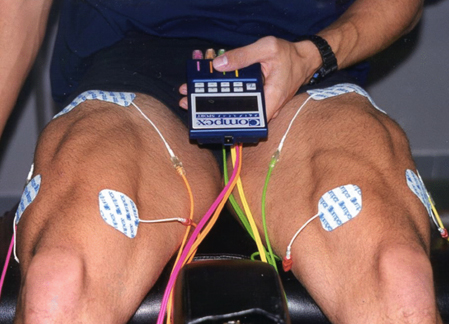
During treatment, electrodes are placed over the target muscle, and the intensity is increased until a strong but tolerable contraction is achieved. This protocol minimizes fatigue while maximizing muscle strengthening


Electrode Placement

Electrodes are placed over the motor points of the target muscle, usually aligned along the direction of muscle fibers to achieve optimal contraction.


Physiological Effects

Physiological Effects

  • Sensory nerves – causing a tingling sensation
  • Motor nerves – producing tetanic muscle contractions
  • Circulatory system – improving blood flow and reducing swelling

The resulting strong contractions can be more effective than voluntary contraction alone in selected rehabilitation settings.


Indications

Russian Current may be beneficial for:

  • Quadriceps Weakness
  • Muscle Atrophy
  • Anterior Cruciate Ligament Injury
  • Osteoarthritis
  • Muscle spasm
  • Post-immobilization weakness
  • Sports conditioning

Contraindications

Russian Current should not be used in patients with:

  • Cardiac pacemakers or serious arrhythmias
  • Deep Vein Thrombosis
  • Active bleeding disorders
  • Cancer in the treatment area
  • Pregnancy (over abdomen, pelvis, or lower back)
  • Recently irradiated tissues
  • Over the carotid sinus
  • Unconscious or non-communicative patients

Precautions

  • Skin irritation or burns may occur if electrodes are poorly positioned.
  • Intensity should always be adjusted according to patient tolerance.
  • Treatment should be performed by trained physiotherapists.

Benefits of Russian Current Therapy

  • Produces strong and effective muscle contractions than voluntary exercise alone in some patients
  • Accelerates muscle strengthening
  • Prevents muscle wasting
  • Improves functional recovery
  • Enhances athletic performance
  • Supports faster post-surgical rehabilitation
  • Helps restore confidence and mobility
  • Complements exercise-based rehabilitation

Summary

Russian Current Therapy is an advanced electrotherapy technique that uses 2500 Hz medium-frequency sinusoidal current delivered in 50 Hz bursts to produce strong muscle contractions. It is widely used to strengthen muscles, prevent atrophy, improve neuromuscular control, reduce spasms, and speed rehabilitation after injury or surgery. When combined with exercise, Russian Current can significantly enhance recovery and restore muscle function effectively.